
Franklin County Parole vs Probation
Parole, probation, and mandatory supervision can all place a released Franklin County person under rules in the community, but the source of authority is different. Parole follows a prison sentence and a board action. Probation comes from a court sentence. Mandatory supervision is a statutory ADOC release path that moves eligible state prisoners to Alabama Bureau of Pardons and Paroles supervision before the final release date. A jail release record may show the person left custody, while the supervision record explains what remains after release.
| Status | What it means | Where to verify |
|---|---|---|
| Parole | The Board allowed a state prisoner to serve part of the sentence under conditions. | ABPP hearing/results pages and the Russellville Field Office. |
| Probation | A court ordered supervision instead of or after custody. | Franklin County court records and supervising office contact. |
| Mandatory supervision | Eligible ADOC inmates are released to ABPP supervision before the release date. | ADOC records, Alabama VNS, ABPP, and statute-based timing. |
| Community corrections | A local court/community-corrections program may supervise the person outside jail. | Franklin County Community Corrections and the court file. |
- Absconder
- A supervised person who has stopped reporting or cannot be located by the supervising agency.
- Violation
- Conduct that may break release or supervision conditions.
- Discharge
- The end of the supervision term or custody obligation.
- Revocation
- A court or board action that can return a person to custody after a violation.
Verify Franklin County Supervision
Start with the event that caused the release. A person released from the Franklin County Detention Center on bond may have a pending court case but no parole status. A person released from ADOC may have parole, mandatory supervision, or end-of-sentence discharge issues. A person sentenced in Franklin County may have probation terms in the court file. Do not use the current jail roster as the sole test because it only shows who is still in the county detention center.
- Check whether the person was released from the county jail, transferred to ADOC, or sentenced in court.
- Use the ABPP scheduled parole hearings page if a parole hearing may be pending.
- Search the ABPP hearing results archive for board action after a hearing.
- Contact the Russellville Field Office for local supervision routing when the person is under ABPP supervision.
- Use the Franklin County Circuit Clerk or Alacourt when the question is probation, sentencing, bond, revocation, or case disposition.
A parole grant should not be read as a same-day release. Release can depend on paperwork, placement, victim notification, electronic monitoring, or other administrative steps. A denial means the person was not granted parole at that hearing. A cancellation means the hearing did not go forward as scheduled.
Franklin County Supervising Office
The local ABPP contact is not the jail. The Russellville Field Office serves Franklin County for parole and probation supervision questions. It is the strongest county-specific supervision source in the research because it gives the actual office, hours, and county served.
Byars Building, Suite 8
501 North Jackson Avenue
Russellville, AL 35653
Phone: 256-332-3071
Fax: 256-331-1227
Hours: Monday-Friday, 8:00 a.m.-5:00 p.m.; closed state and federal holidays
The Russellville Field Office page lists Franklin as the county served. Use this office for supervision contact, not for a same-day county jail release list. For a jail release, use the Franklin County Detention Center and the sheriff's 48-hour release feed.
Franklin Community Corrections
Franklin County also appears in the ADOC Community Corrections list. The listing identifies Franklin County Community Corrections with Shea Madden, 410 North Jackson Avenue, P.O. Box 790, Russellville, AL 35653, phone 256-332-8856. This matters because some people are no longer in the jail but remain tied to a court or community-corrections program. That status is separate from parole and separate from the sheriff's online release feed.
For a released person who says they are reporting locally, compare the court docket, any sentencing order, and the listed supervising program. The jail release date proves the booking ended. The supervision record or court order explains what the person must do after release.
Franklin County Parole Hearings
ABPP publishes scheduled parole hearings and hearing results rather than a simple county parolee search. The schedule is forward-looking and can change. Result posts are grouped by hearing dates and can summarize grants, denials, and other outcomes. For Franklin County, search by name or AIS when a state-prison case may have reached a parole hearing.
Alabama Code Section 15-22-28 sets parole consideration rules. For specified Class A felonies committed by prisoners convicted on or after March 21, 2001, initial parole consideration is after 85 percent of the total sentence or 15 years, whichever is less. For other prisoners, the timing is generally one-third of the sentence or 10 years, whichever is less, subject to the statute and board procedures. Consideration is not the same as release.
The ABPP hearing pages show the scheduled hearings and decision archives used for Franklin County parole and probation checks.
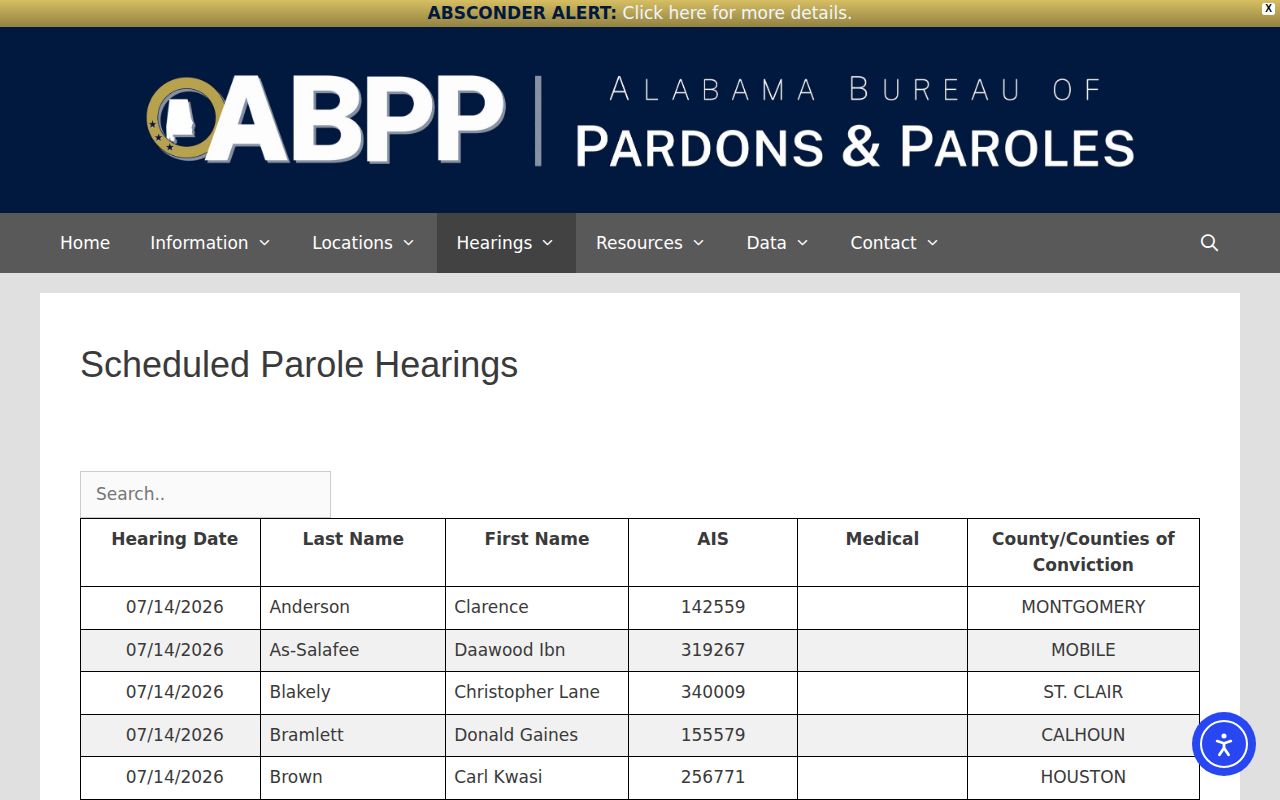
The image documents the statewide hearing schedule path; local supervision questions still route through the Russellville Field Office.
Violations and Absconder Status
Supervision conditions vary by order, but common categories include reporting, residence approval, travel limits, treatment, fee obligations, no-contact terms, and compliance with new court orders. A violation does not always mean immediate custody, but it can lead to a warrant, revocation hearing, additional conditions, or return to jail or prison. When a person has stopped reporting, the word absconder may appear in supervision contexts.
The research did not verify a Franklin County-specific public absconder list. Use ABPP sources, the Russellville Field Office, and the court docket instead of guessing from the jail roster. If a person on supervision is arrested or revoked, the county jail may show a new booking, but the underlying supervision issue will still be explained by ABPP or court records.
Franklin Supervision Discharge Records
Supervision ends when the legal term is discharged, the court or board changes the status, or another custody event interrupts the supervision. A discharge from parole or probation is different from a jail release. The jail release record shows when the person left a booking. The supervision discharge record shows when community supervision obligations ended. For state-prison release cases, Alabama VNS, ABPP, and ADOC public records may all be relevant.
For a complete release picture, compare the Franklin County released inmates search path with the court record and supervising-agency source. A person can be released from the jail and still have probation. A person can be granted parole and wait on administrative steps. A person can leave ADOC custody and still report to ABPP under mandatory supervision.
Public Record Search
Sponsored Results